Rotate your view and the bass slides behind you. Zoom in and the particles fill your screen. The attractor never repeats, but it never escapes either. Chaos Studies is now available on the App Store.
What Are Strange Attractors?
In mathematics, a strange attractor is what emerges when a chaotic system settles into a pattern that is infinitely complex but never random. Take a set of simple equations — three variables, a handful of constants — and iterate. The output traces a shape in space that folds over itself endlessly, never crossing its own path, never exactly repeating. Deterministic chaos: every point is precisely determined by what came before, yet the trajectory is impossible to predict.
The most famous is the Lorenz attractor, discovered by meteorologist Edward Lorenz in 1963 while modelling atmospheric convection. Its twin-lobed, butterfly-shaped orbit became the visual icon of chaos theory.
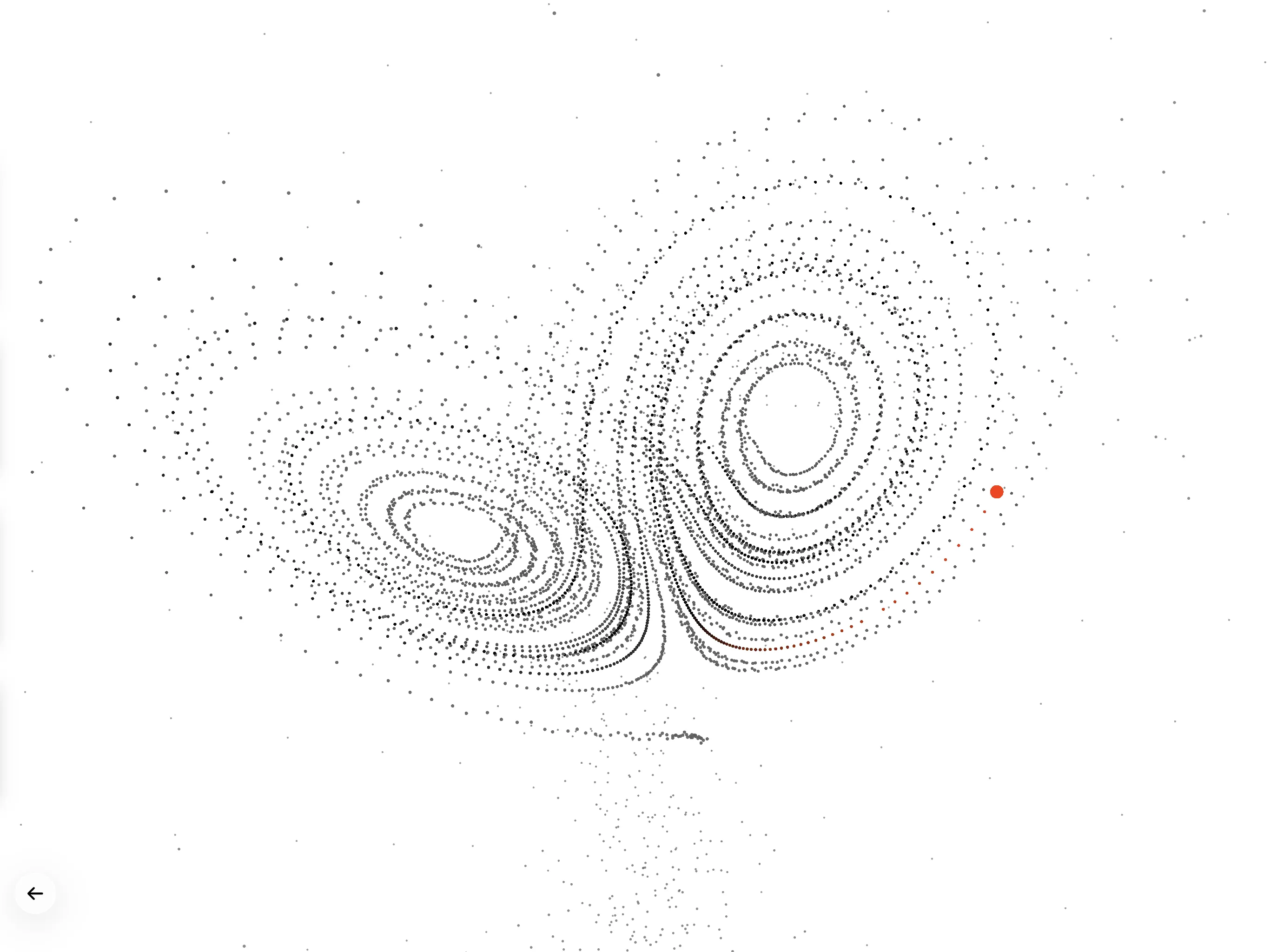
But there are many others — Rössler, Halvorsen, Aizawa, Thomas — each with its own geometry and temperament. Some feel organic. Others feel architectural. All of them are beautiful.
Chaos Studies lets you hold these systems in your hands.
From Playdate to Full Power
The first version was built for the Playdate — Panic’s tiny handheld with a crank and a 1-bit display. That constraint forced clarity about what mattered most: the visual rhythm of particles tracing deterministic-yet-unpredictable paths, and the physical delight of manipulating chaos with a crank.
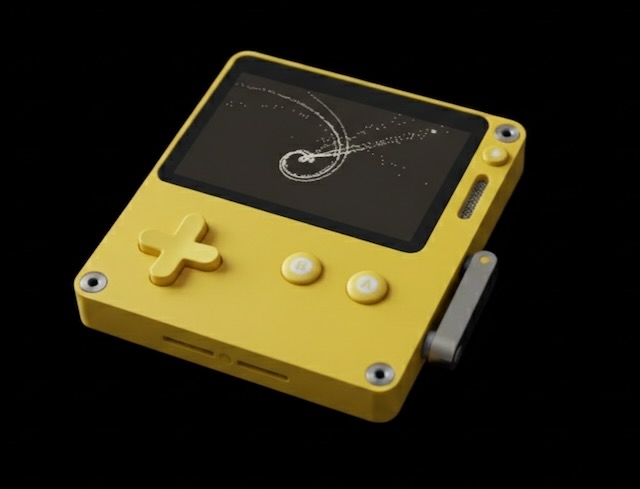
Porting to iOS and macOS meant shedding those constraints. Full colour. Spatial audio. Multi-touch. But the core idea carried over: give someone direct, tactile control over a chaotic system and let them feel its behaviour.
Sound in Space
Seven music stems positioned in 3D — percussion in front, cello behind, drones below. Rotate the attractor and the soundscape rotates with it. A cursor synthesiser tracks the current particle through phase space, its bass frequency tied to velocity. Headphones reveal the full effect.
No Goal
There’s no score. No puzzle. No progression. It exists purely as something to sit with — art that doesn’t need to serve a purpose beyond itself.
Chaos Studies is available for iPhone, iPad, and Mac.